Stone settings explained: pavé, halo, bezel, prong and chaton
The same stone can look completely different, depending on how it's held. Here's how to read a setting, and choose one that suits your life.
Atelier TOV6 min readUpdated 15 November 2026
The short answer
A setting is how a stone is held in the gold. Prongs hold the stone high in the light, for maximum sparkle. A chaton is a small cup with prongs, stone by stone. A bezel wraps the stone in a rim of gold: the most secure, and nothing catches. Pavé is a surface full of tiny stones, and a halo is a circle of small stones around a centre stone.
A setting is the bit of gold that holds a stone. A small detail that decides three things: how much light reaches the stone, how big it looks and how well it's protected.
At TOV you'll see five settings. Pavé is the one we use most, then prongs, bezel and halo. Here's how they compare:
Setting
How it looks
How secure
For every day
Prong
One stone held high, lots of light
Secure, check the prongs now and then
Maximum sparkle, can catch on knitwear
Chaton
A small cup with prongs, stone by stone
Secure, each stone on its own
Even sparkle, the classic for tennis bracelets
Bezel
A smooth rim of gold all around
The most secure
Nothing sticks out, nothing catches
Pavé
Lots of tiny stones close together
Tiny stones, needs a little care
Sparkle across the whole surface
Halo
A circle of small stones around a centre stone
As secure as the settings within it
Big effect in a fine size
Cubic zirconia or diamond: the setting works the same way. The difference between the stones themselves is in cubic zirconia vs diamond.
Prong and chaton: the stone in the light
Prong
Prongs, also called claws, are the small gold tips that grip a stone, usually four or six. With four you see more of the stone. Six hold it extra firmly and make it look rounder. The stone sits high and light comes in from every side, so it sparkles as much as it can. That's why this is the classic setting for a solitaire ring.
The only downside: a high stone can catch on a jumper or a scarf. Check now and then that all the prongs still sit neatly against the stone.
Our Four Prong Diamond Solitary Pavé Tapered Ring shows how it works: one bright diamond held high in four prongs, with tiny pavé diamonds along the band. The Beaded Four Prong Cubic Zirconia Ring does it in miniature: one cubic zirconia about the size of a sesame seed.
Good to know: the Diamond Claw Ring is named after its shape, not its setting. It ends in two tapered claws: one polished, the other lined with a row of pavé diamonds.
Chaton
A chaton is a small gold cup with prongs at the top. Each stone gets its own cup, so light comes in from the sides too. Our Cubic Zirconia Tennis Bracelet has 58 cubic zirconia, each in its own chaton, for an even sparkle. Everything about that bracelet is in tennis bracelet.
Bezel: gold all around
In a bezel setting, a smooth rim of gold runs all the way around the stone. The stone sits deep and protected, and nothing sticks out. That's why a bezel catches least and copes best with a knock. You see a little less of the side of the stone and a little more gold: clean, graphic and modern.
Our Bezel Set Cubic Zirconia Eternity Ring has eleven cubic zirconia set flush into a flat band, all the way round. Nothing sticks out or catches. On the Bezel Set Diamond Tennis Bracelet, each diamond sits in an illusion setting inside a round rim of gold: a bright little surface that reflects the light.
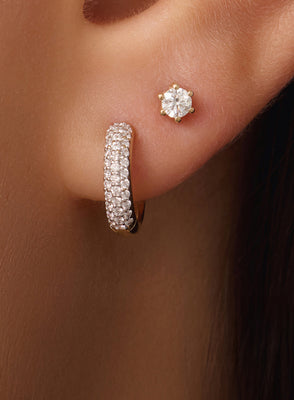
Pavé is French for paved, and that's exactly how it looks: lots of tiny stones close together, as if the gold were paved with them. Tiny beads of gold hold each stone in place. The result is sparkle across the whole surface, even without a big stone.
Our Pavé Cubic Zirconia Bar Hoop Charm is a bar of about 17 mm, lined with cubic zirconia from top to bottom. On the Half Pavé Diamond Linked Pendant Necklace, one half of an open heart is set with nine natural diamonds, the other half is polished gold.
Because the stones are tiny, pavé needs a little more care. Take a pavé ring off for sport and DIY.
Halo
A halo is a circle of small stones around a centre stone. Together they look like one bigger stone, and light comes in from every side. That's why a halo is such a favourite for an engagement ring: a big effect, in a fine size.
Our Diamond Halo Ring has a centre stone in a halo of small natural diamonds, 0.05 ct in total. The Pavé Four Prong Diamond Halo Ring has a halo held in four slim prongs and diamonds along both sides of the band: twenty diamonds, 0.13 ct in total. Our diamonds are always natural, F-G colour and SI clarity. What that means is in F-G SI diamond.
Which setting suits you, and how do you care for it?
Choose on what you love, and on how you live:
Busy hands? Choose a bezel. Smooth, protected and nothing catches.
Want as much sparkle as possible? Choose prongs or a halo.
Want shine without a big stone? Choose pavé.
Every setting is checked before a piece gets its hallmark. A few habits keep your piece beautiful:
Take pieces with stones off for sport, DIY and cleaning.
Put them on after your lotion and perfume. Those can make gold and stones look dull.
Polish only the gold with a soft cloth, and freshen the stones with lukewarm water.
Store each piece on its own, so nothing scratches.
Every piece comes with a two-year warranty. For the setting of stones it's one year: a loose stone caused by a fault in the setting is covered. More on our warranty and repairs page.
A ring with lots of tiny stones set close together, so the gold looks paved. Pavé gives sparkle across the whole band, even without a big stone. Polish only the gold and freshen the stones with lukewarm water.
What is a halo ring?
A ring with a centre stone in a circle of small stones. Together they look like one bigger stone, and light comes in from every side. Our diamonds are always natural, F-G colour and SI clarity.
What is a bezel setting?
A smooth rim of gold all the way around the stone. The stone sits deep and protected and nothing sticks out, so a bezel doesn't catch and copes well with everyday wear.
Which stone setting is the most secure?
A bezel, because the rim of gold protects the stone all round. Prongs and a chaton hold a stone firmly too, but the stone sits higher, so check now and then that the prongs still sit against it.
What is the difference between a prong and a chaton setting?
Prongs are separate tips that hold one stone high, often on a solitaire ring. A chaton is a small cup with prongs that holds each stone on its own, as in a tennis bracelet or a stud.
 Black Friday
 Gifts
 New
 Bestsellers


 Earrings


 Rings


 Bracelets


 Necklaces

 Diamonds

 Piercings


 Sets
 Sale