F-G SI diamond: what does it mean, and is it good?
Four letters on a certificate. Here's what they tell you about your diamond, and what they don't.
Atelier TOV5 min readUpdated 12 November 2026
The short answer
Yes, an F-G SI diamond is a real diamond, and a very good choice to wear every day. F-G is the colour: near colourless, icy white, with no yellow to see. SI is the clarity: small natural inclusions you usually only see with a loupe. Together they give you a bright, sparkling stone, without paying for differences the naked eye can't see.
Yes. F-G SI isn't a type of diamond, and it isn't an imitation. It's a grade: two of the four points every diamond is assessed on. F-G is about colour, SI about clarity. Together they tell you what the diamond looks like, not whether it's real.
What they don't tell you either: where the diamond comes from. At TOV every diamond is natural, across all our gold diamond jewellery.
The 4 Cs in one table
Every diamond is assessed on four points, and they all start with a C: colour, clarity, cut and carat.
What it tells you
The scale
At TOV
Colour
How white the diamond is
D (colourless) to Z (yellowish)
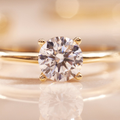
F-G: near colourless, icy white
Clarity
How many natural inclusions it has
FL (flawless) to I (visible inclusions)
SI: small inclusions, usually only visible with a loupe
Cut
How it's cut, and so how it sparkles
Shape, proportions and facets
Mostly brilliant: round, with 57 facets
Carat
How much the diamond weighs
1 ct is 200 milligrams
Shown per piece on the product page
Colour: from D to Z
The colour scale runs from D to Z. The further down the alphabet, the more yellow you see.
D, E and F: colourless.
G to J: near colourless.
K, L and M: faint tint.
N to Z: light yellow to yellow.
F-G sits right on the line: F is the last letter of colourless, G the first of near colourless. Set in gold, you see an icy white stone.
Clarity: where does SI sit?
Almost every natural diamond carries tiny traces of how it grew deep in the earth. They're called inclusions. The clarity scale tells you how many you see at ten times magnification.
Grade
Meaning
What you see
FL, IF
Flawless
No inclusions, not even with a loupe
VVS1, VVS2
Very, very small inclusions
Hard to find even with a loupe
VS1, VS2
Very small inclusions
Findable with a loupe
SI1, SI2
Small inclusions
Visible with a loupe, usually not with the naked eye
I1, I2, I3
Visible inclusions
Sometimes visible to the naked eye
SI stands for slightly included. It sits in the middle of the scale: the inclusions are there, but you have to go looking for them.
Why F-G and SI is a smart choice for every day
You don't wear a diamond under a loupe. You wear it on your hand, in your ear or round your neck. What counts is what you see there.
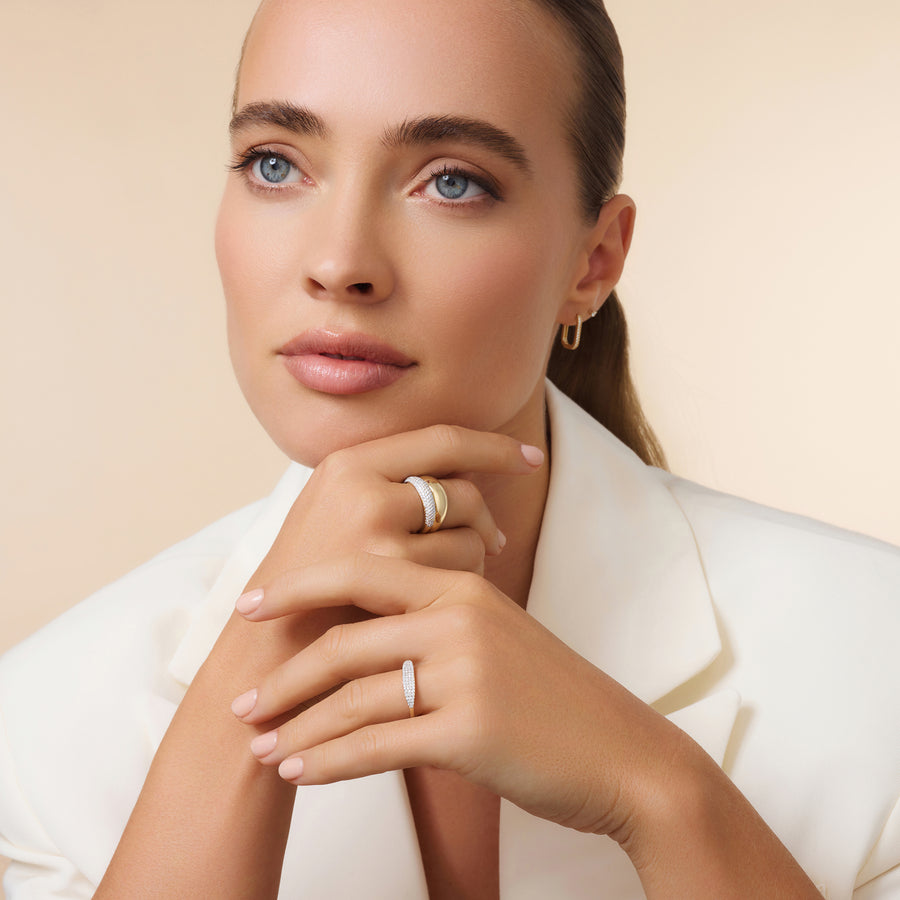
You see white, not yellow. F-G is bright enough to look icy white next to both white gold and yellow gold.
You see sparkle, not inclusions. With SI you usually see nothing with the naked eye. In small stones, like those on most jewellery, it shows even less.
You don't pay for the loupe. Every step up the scale makes a diamond a lot more expensive, for a difference you can't see when you wear it.
It can take a knock. Diamond is the hardest natural material and very scratch resistant. Exactly what you want in a ring you never take off.
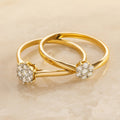
Same ring, three weights: this is what carat does. Choose a diamond engagement ring and you get the same colour and clarity, whichever weight you pick.
With the certificate. Every TOV piece comes with a personal digital certificate of authenticity. For diamonds, it states the cut, colour, clarity and carat weight. You'll also find the exact weight on every product page, across all our gold diamond rings.
Buying a diamond somewhere else? Always ask these four questions: which colour, which clarity, how many ct, and natural or lab-grown? A good seller knows straight away. More on the 4 Cs is in our diamond guide.
Natural or lab-grown?
A lab-grown diamond is a real diamond too: the same carbon, the same hardness, the same sparkle. It gets graded on the same 4 Cs, so a lab-grown diamond can be F-G SI as well. Only the origin differs: a natural diamond grew in the earth, a lab-grown one in a lab. We work with natural diamonds. The whole story is in lab-grown vs natural diamond. Rather not have a diamond? Then cubic zirconia set in real gold is a lovely alternative.
Yes. F-G SI is a grade for colour and clarity, not a type of stone. It tells you what the diamond looks like, not whether it's real. At TOV every diamond is natural.
Is an F-G SI diamond good?
Yes, especially for jewellery you wear every day. You see an icy white, sparkling stone, and the small inclusions usually only show under a loupe.
What does SI mean for diamonds?
SI stands for slightly included: small natural inclusions. On the clarity scale from FL to I, SI sits in the middle. You usually can't see them with the naked eye.
Which is better: F or G colour?
F is a touch whiter: the last step of colourless. G is near colourless. Side by side, only a trained eye sees the difference. When you wear it, nobody does.
How much is 1 carat of diamond?
1 carat (ct) is 200 milligrams. The diamonds on jewellery are often much smaller: at TOV, for example, 0.05, 0.10 or 0.15 ct. The exact weight is on the product page and on your certificate.
 Gifts
 New
 Bestsellers

 Rings


 Bracelets


 Earrings


 Hoops
 Piercings


 Necklaces

 Diamonds

 Sets
 Sale