Helix piercing: where it sits, how it feels and which piece fits
The upper rim of your ear, where a line of gold looks its best. What to know before you get it done, and after.
Atelier TOV6 min readUpdated 11 November 2026
The short answer
A helix piercing sits in the upper rim of your ear, through the cartilage. Getting it done feels like a short, firm pinch or pressure. Allow six to twelve months to heal, sometimes longer, and ask your piercer when you can change your jewellery. After that, wear a flat-back stud, usually with a 5 or 6.5 mm post, or a small hoop that clicks shut.
Follow the rim of your ear from the top down: that curved edge of cartilage is the helix. You can have a piercing placed almost anywhere along it, from the very top to halfway down your ear. A few variations have their own name:
Type
Where
What it does
Helix
The upper rim of your ear
A single dot of gold along the edge
Double or triple helix
Two or three piercings in a row along the rim
A little line of gold
Forward helix
At the front, where your ear meets your head
A detail close to your face
Double forward helix
Two forward helix piercings, one above the other
Fine and playful, easy to see from the front
You'll find every part of your ear on the ear map below. For more on the tragus, conch and flat, read helix, tragus, conch or flat.
The ear map
Tap a spot
Every spot has its own piercing. Tap to see where it sits and what fits.
Helix
The upper rim of your ear: made for stacking small studs.
Everyone feels it differently. Most people describe a short, firm pinch, followed by a warm, throbbing feeling. Cartilage is firmer than your lobe, so it feels sharper than your first ear piercings. That said, the rim of your ear is thinner than the cartilage deeper inside, as with a conch piercing.
For the first few days, your ear will feel warm and tender. That's normal.
How long does it take to heal?
Cartilage heals slowly. Allow six to twelve months, sometimes longer. Your piercer keeps an eye on it and tells you when you can change your jewellery.
Your piercer chooses your first piece, because it has to suit a fresh piercing.
Don't sleep on that side for the first few weeks. A travel pillow with a hole in the middle helps.
Don't twist your jewellery and touch it as little as possible.
Watch out for hairbrushes, jumpers and headphones: anything that catches will irritate it.
Still red, warm or painful? See your piercer or GP.
Stud or hoop: what fits your helix?
Once your helix has healed, you choose between two types.
A stud
A helix piercing with a stud is the easiest choice. Our piercings have a flat back: a small flat disc that rests against your head, with a top you screw onto the post. You won't notice it when you sleep or take a call. A sphere, a star or a single stone: anything works in a helix. Want sparkle? Choose a diamond piercing: natural, F-G colour and SI clarity.
A hoop
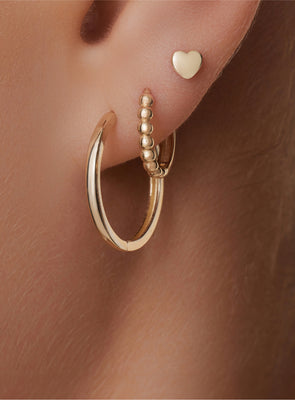
A hoop adds movement and curves beautifully around the rim of your ear. Our 9 mm cartilage hoops click shut. Do check with your piercer that your helix is ready: a hoop moves more than a stud, so wait until it has fully healed.
The length of the post decides how your stud sits. Too short pinches, too long sticks out from your ear. Almost all our piercings come in three lengths: 51 of our 62 are available in 5, 6.5 and 8 mm. The post is 1 mm thick.
Length
How it sits
In a helix
5 mm
Close to your ear
When the cartilage there is thin
6.5 mm
The standard, with a little room
Fits most helixes
8 mm
More room behind your ear
For thicker cartilage
Not sure? Measure a piercing you already wear comfortably, or ask your piercer how long your post is. If you currently wear a thicker post, check that 1 mm works for you.
Pairing with the rest of your ear
A helix is the top of your ear stack. Keep it smaller than what you wear in your lobe: bigger at the bottom, smaller towards the top. A row of two or three tiny spheres in your helix with a huggie in your lobe always works. For more combinations, see how to build an ear stack.
Not ready for a needle yet? An ear cuff at the top of your ear gives you the same line of gold, no piercing needed.
All our piercings are real gold, 14 or 18 karat, nickel-free and suitable for sensitive skin. They're sold individually, so you choose exactly what you want for each spot.
It feels like a short, firm pinch followed by a warm, throbbing feeling. Cartilage feels sharper than your lobe, but everyone experiences it differently. Your piercer will tell you what to expect.
How long does a helix piercing take to heal?
Usually six to twelve months, sometimes longer. Cartilage heals more slowly than your lobe. Your piercer will tell you when it's safe to switch to a gold piercing.
What is a forward helix?
A forward helix sits at the front of your ear rim, close to your face, where your ear meets your head. Two, one above the other, is called a double forward helix.
What length piercing do I need for a helix?
Usually 5 or 6.5 mm. 5 mm sits close to your ear, 6.5 mm is the standard and gives a little more room. For thick cartilage, choose 8 mm.
Can I wear a hoop in my helix?
Yes, once your helix has fully healed. A hoop moves more than a stud, so ask your piercer whether it's time. Our 9 mm cartilage hoops click shut.

 Gifts
 New
 Bestsellers


 Rings


 Bracelets


 Earrings


 Hoops
 Piercings


 Necklaces

 Diamonds

 Sets
 Sale